
Issue 112 - Clean Tech Green Shoots, Robot Arms, and a $100B Bet on American Manufacturing
Breaking the Bottleneck | 3/23/2026

Breaking the Bottleneck is a weekly-ish newsletter and interview series about manufacturing and physical AI. If you want to chat, feel free to reach out at aditya@machinafactory.org or on LinkedIn!
One Big Thing
Rhodium Group just dropped its latest Clean Investment Monitor report, with the renewable value chain now a nearly $2 trillion annual capital allocation event. But the growth rate tells a different story. Clean-tech deployment investment grew 33% in 2022, 28% in 2023, then hit a wall, 8% in 2024, 7% in 2025. And while deployment keeps climbing, manufacturing investment has fallen off a cliff.
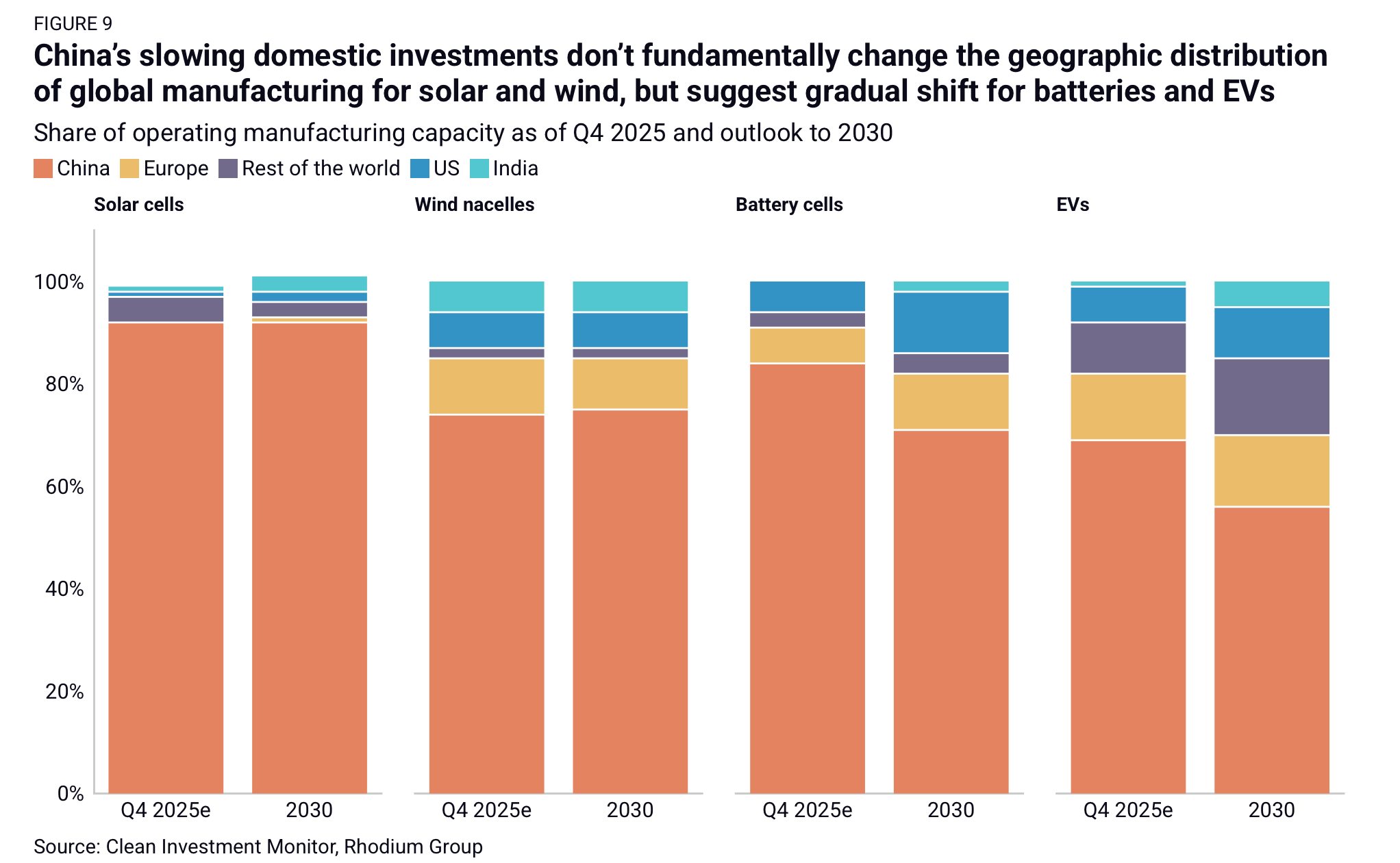
Global manufacturing and industry investment totaled $155 billion in 2025, a 35% decline from 2024 and over 40% below the 2023 peak. Solar manufacturing alone collapsed 69%. The primary driver? China. Chinese firms accounted for over 70% of global growth in clean-tech manufacturing through 2023, then pulled back sharply as Beijing tried to rein in the overcapacity that sent prices plunging across the EV and battery supply chains, and created an “involution” in the EV market. Ye,t even after that drawdown, China still holds 92% of global solar cell capacity, 74% of wind nacelle capacity, 84% of battery capacity, and 69% of EV manufacturing capacity. The investment is declining because the factories are already built.
The U.S. story is the exact opposite. Q4 2025 set a record for canceled manufacturing investment, with roughly $8 billion in projects killed. Across 2025, 19 EV supply chain manufacturing projects representing $22 billion in planned investment were canceled, exceeding the $21 billion in new announcements. When cancellations outpace new commitments, that's not a slowdown. That's capital fleeing.
What makes this worse is that China isn't just sitting on its domestic capacity. For the first time in 2024, Chinese companies invested more in EV supply chain capacity overseas than at home. The U.S. isn't competing with China's factories. It's competing with China's ability to project manufacturing capability into friendlier jurisdictions. The risk for the U.S. and Europe is that their domestic manufacturers never reach the scale to survive a global price war with producers who've already amortized their capital costs.
There are green shoots, though. Of all new battery cell manufacturing investments announced in 2025, BESS-specific projects hit a record of over $15 billion globally. In the U.S., 97% of new battery manufacturing investment was geared toward energy storage, up from essentially nothing two years earlier. Several U.S. companies have already pivoted production lines from EVs to BESS, collectively accounting for nearly a quarter of current operational capacity, as grid-scale storage demand accelerates on the back of renewable integration and the data center buildout. That kind of manufacturing flexibility is exactly the adaptive behavior the U.S. clean-tech sector needs more of. And if the U.S. can't be the alternative to China, India might be. Their clean-tech manufacturing investment grew 17% in 2025 to $11.4 billion, with the country on track to have the largest manufacturing capacity for batteries, solar, and wind outside China and the U.S. by 2030.
This is what should be driving the conversation in Washington. Domestic manufacturing of solar panels, batteries, and storage equipment means jobs that are hard to automate, rooted in physical production, and resistant to offshoring once established. It hedges against energy volatility, the kind playing out right now with the Iran conflict, and it gives the rest of the world an alternative to Chinese-produced energy infrastructure. [Report Link Here]
Content I Enjoyed Last Week 🗞️🔬 📚
Some Interesting Reads:
A great breakdown of World Models from Packy McCormick, is well worth the read alongside the World Model Research Archive he’s put together. The Archive will definitely keep me busy for a few weeks.

An interview with Tractian CEO, Igor Martinelli, around the future of physical AI and the playbook that has fueled Tractian’s rapid growth. [NGP Capital]
GM launched its engineering blog this past week with a few interesting blog posts on its approach to scalable autonomy [GM]
A great breakdown from Aaron Slodov on what to read around reindustrialization and manufacturing. [X]
Skild is deploying its models with ABB, UR, and NVIDIA. [Skild]
An interview from CES with Mikell Taylor, head of robotics strategy at General Motors, on the future of robotics. [McKinsey]
The Chinese adjustment to the rebalancing of supply chains. [Fortune]
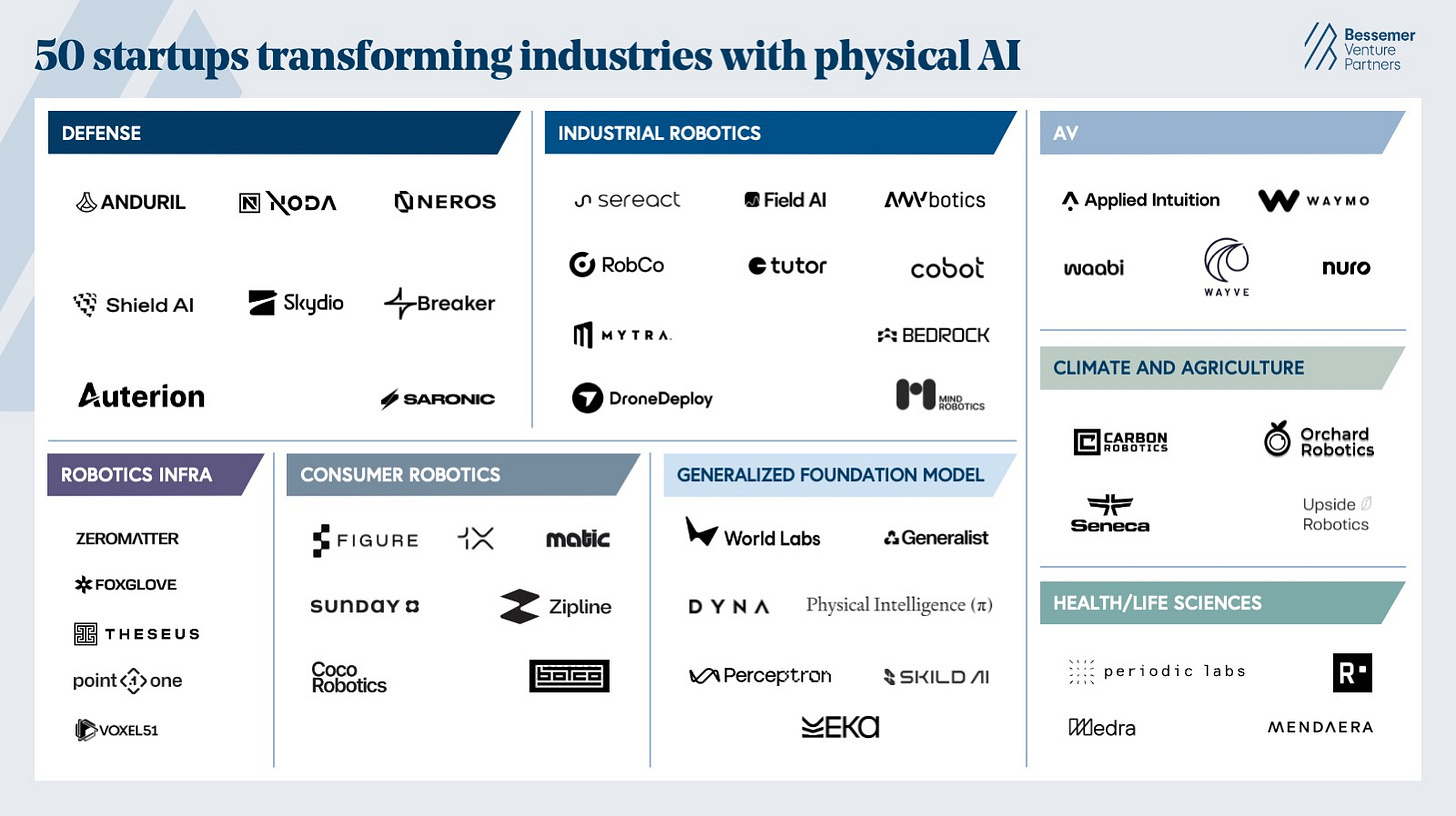
A new market map with 50 Physical AI startups [Bessemer VC]
Uber is investing up to $1.25 billion in Rivian to deploy autonomous robotaxis [Rivian]
Jeff Bezos is raising $100 billion for a new fund that would roll up manufacturing companies and integrate AI. [WSJ]
Here are some of the highlights from NVIDIA GTC:
Built on NVIDIA Warp and OpenUSD NVIDIA announced Newton 1.0 GA a production-ready foundation for dexterous manipulation and locomotion tasks.
The NVIDIA CloudXR 6.0 suite of streaming technologies, now natively integrated with Apple Vision Pro to enable spatial interaction with apps like Immersive for Autodesk VRED.
A Roche case study demonstrating the use of NVIDIA Omniverse libraries to build digital twins of production facilities to simulate and optimize complex systems before they go live.
McLaren is leveraging the Rescale digital engineering platform powered by NVIDIA to reduce simulation times.
A detailed breakdown of how robotics companies are using Newton and Groot to build robotics with AI.
NVIDIA is partnering with Cadence, Dassault Systèmes, PTC, Siemens, and Synopsys to bring GPU-accelerated tools and Omniverse to major manufacturers, including Honda, Mercedes-Benz, Samsung, TSMC, and PepsiCo.
Products & Research:
Jiga, put together a guide on the 7 DFM principles that should underpin every design decision. Covers why manufacturability needs to happen early, not as a final check, and how to work with suppliers before your leverage disappears. Check it out here.
Velotic launches, combining Proficy, GE Vernova’s former manufacturing software business, and PTC’s ThingWorx and Kepware businesses. [TPG]
PreScalar, a new AI and automated-testing platform for manufacturing, launches! [PreScalar]
High availability in Litmus Edge is now available. [Litmus]
Fictiv introduces Instant Injection Molding Quoting [Fictiv]
An interview as part of YC’s Hard Tech, with the founders of Solugen talking through their enzymatic and catalytic production process, the transition from a $7K PVC reactor to a scaled plant in Houston, and the future of American manufacturing. [YC]
Databricks demoed a case study alongside Toyota for its new real-time streaming product Zerobus Ingest, integrated with global IoT connectivity from Soracom, to mitigate maintenance costs and transform its manufacturing operations. [Databricks]
Blogs / Threads
Part 2, and a must-read, on PoC Valley in Industrial Tech from Trista Li

Finance & Transactions 💵
Roboforce raised $52M from YZi Labs
Robotics / Physical AI • Series A • USA
Solugen raised $50M from Idealist Capital and Canada Growth Fund
Chemical Manufacturing • Growth • USA
Tenkara raised $7M from True Ventures
Manufacturing AI • Seed • USA
Planned Downtime 🧑🔧
Dune Part 3
Breaking the Bottleneck is brought to you with support from our partners.
Jiga - Is a platform that connects hardware teams with vetted manufacturers for custom parts. Instead of black-box instant quotes, you see exactly who’s making your parts and can talk to them directly.
Industry 4.0 Club - Leading cross-functional group accelerating the adoption of Industry 4.0, delivering better experiences to consumers, better profits to manufacturers, and better jobs to factory workers.
Ironloop - Ironloop is a modern OT/ICS software platform that delivers configuration-level intelligence, giving manufacturers ground-truth security visibility and compliance confidence across air-gapped networks.
T51 - T51 is an AI-native planning, scheduling, and optimization platform that integrates securely with your existing ERP, MES, and data stack.