
🏭 Breaking the Bottleneck is a weekly newsletter and interview series covering manufacturing technology and physical AI. Want to chat? Reach out at aditya@machinafactory.org or connect with me on LinkedIn.
This newsletter is brought to you with support from our featured partners: AMT, IMTS, Ironloop, Upkeep, and Industry 4.0 Club.
The Agentic Workforce on the Factory Floor🎙️
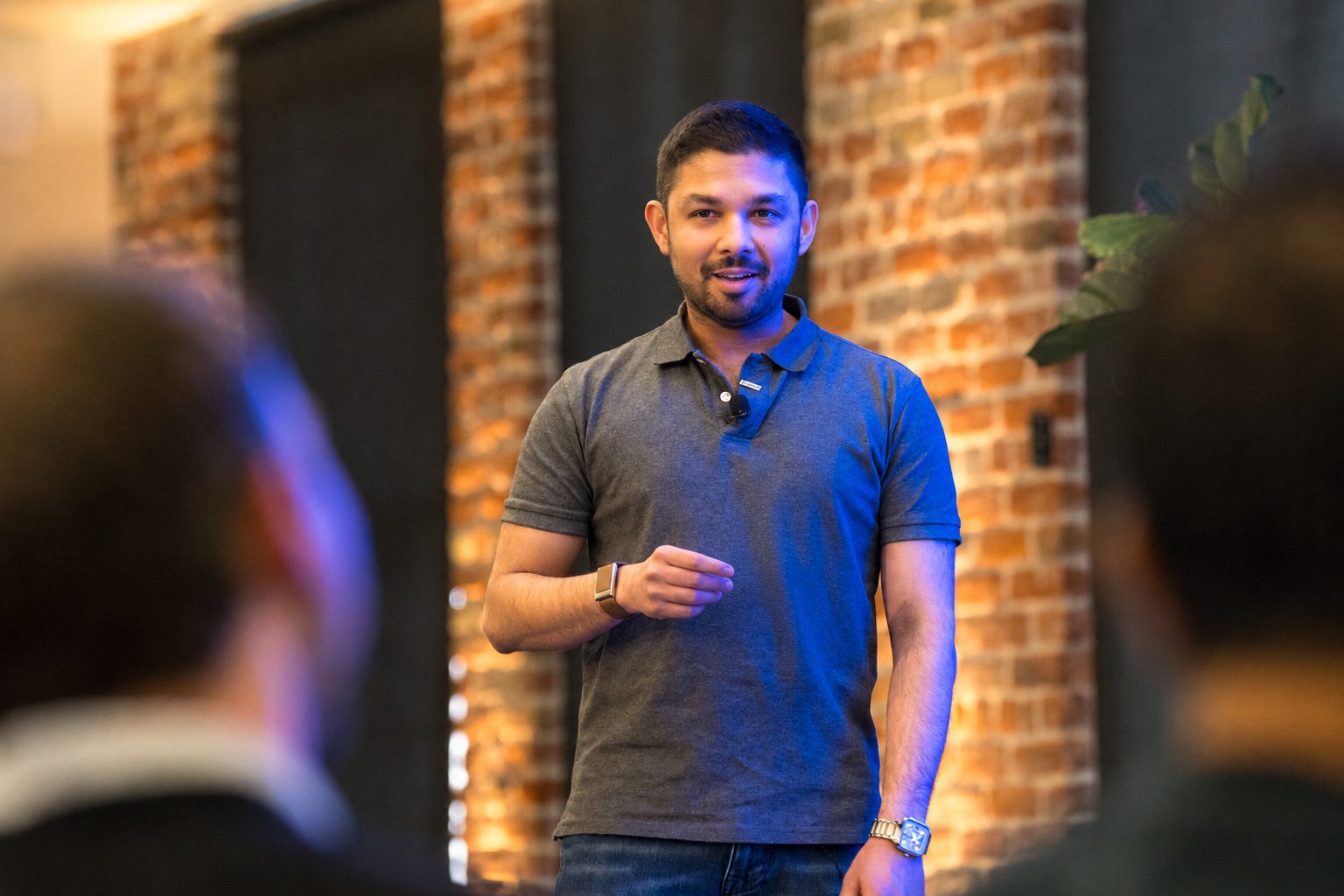
Capturing tribal knowledge is defense. Agents are offense. This launch is about moving from surfacing what an organization knows to acting on it directly.
Capturing tribal knowledge is defense. Agents are offense. This launch moves from surfacing what an organization knows to acting on it directly.
Squint already runs across thousands of industrial facilities and tens of thousands of operators, from Fortune 500 plants like PepsiCo and Continental down to smaller manufacturing and field service shops in niche industries. Its Tribal Knowledge Agent solved a problem no system had cracked before: turning the expertise locked in veteran operators’ heads into procedures, work instructions, and on-the-job answers. Recently, Devin and his team have been launching the Industrial Agent Platform, which doesn’t just surface that knowledge, it starts acting on it. I sat down with Devin to understand how the graph underneath it all came together and why agents are the obvious next move.
Squint started by capturing tribal knowledge and turning it into procedures, work instructions, and on-the-job answers. The Industrial Agent Platform moves from surfacing that knowledge to acting on it. Walk me through how the original product came together and what changed along the way that made this launch the obvious next step.
Squint predated ChatGPT. Our thesis was that generative AI would take off, but industrial AI would be missing the one thing that mattered most: context. Structured data alone is a very small slice of the context you need to take the right action in an industrial setting. In finance, data captures something like 80% of the context. In industry, that ratio is inverted. The rest lives in tribal knowledge, and that knowledge is what flavors the data and fills the gap. From the start, we brought in multimodal data. However, our proprietary model for building custom knowledge graphs launched in June 2026. MES, CMMS, video, manuals, and dashboards all flow into one connected context layer.
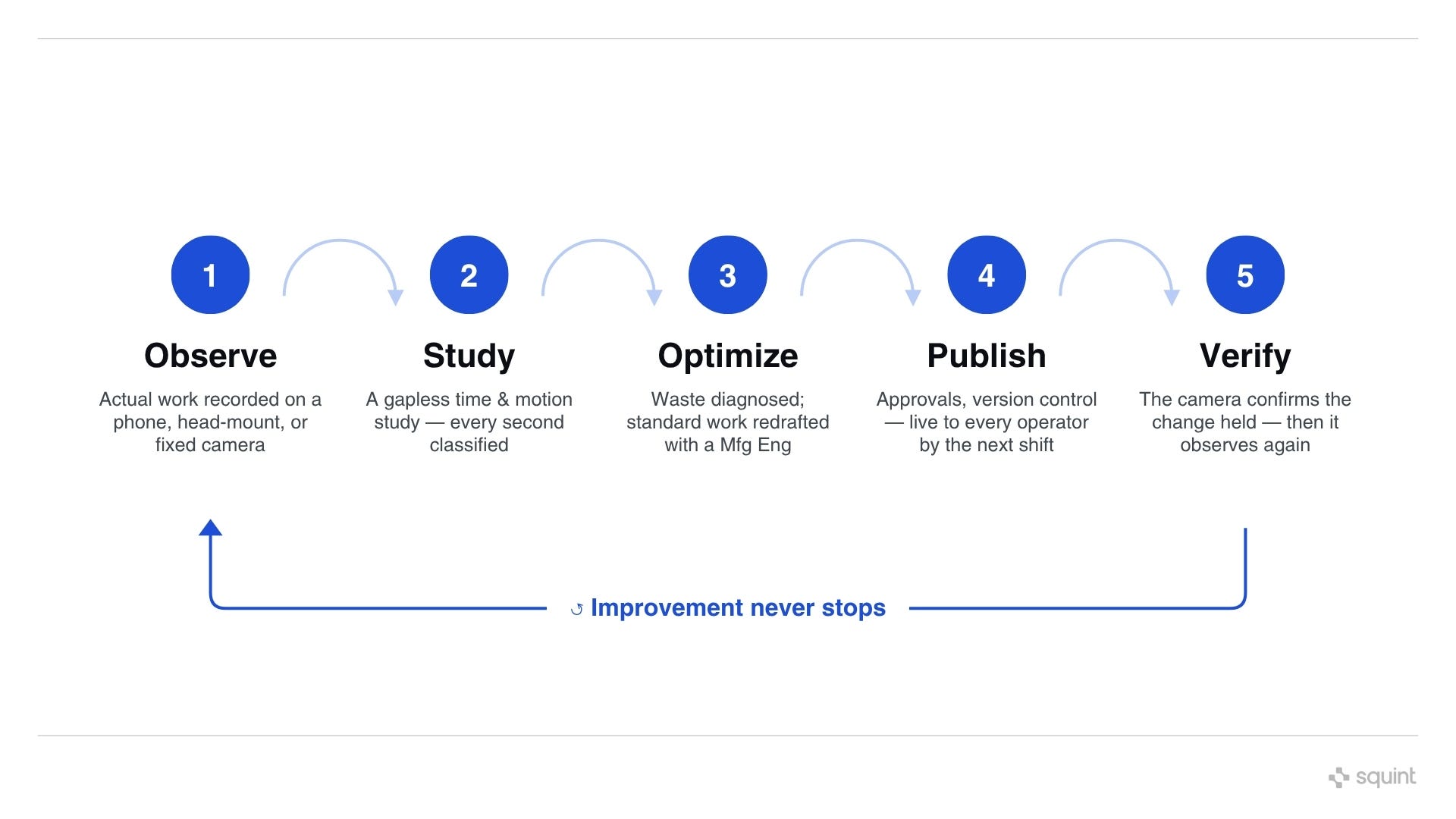
Here is what we learned. You do not get ROI from capturing tribal knowledge alone. That is defense. Agents are the offense. Take our Lean manufacturing agent, which applies classic DMAIC principles. It starts by understanding the goal and the constraints. Then it analyzes video footage of the plant, separating value-add from non-value-add work and identifying which of the seven forms of waste apply. It produces a full-time-and-motion study automatically. From there, it proposes an optimal process for the goal you actually care about, whether that is throughput, quality, or labor cost, and computes the right permutation for that situation. That optimal process becomes the new standard work, and Squint auto-generates the work instructions, training, skill measurements, and curriculum to go with it. We feed company policies and PPE standards in as guardrails, so the output is compliant by construction. The platform is now enriched with the best way to do something, not just a way to do it.
You describe AI onramps that pull in everything an organization knows, and a model that generates a knowledge graph custom to each customer. What kinds of data are flowing into that graph today, and how does the model handle it when two customers describe the same equipment, procedure, or failure in completely different terms?
The graph’s richness depends on what the customer connects, and we are seeing a consistent set of inputs. MES connected to IoT sensors, feeding the dashboards and values that matter to that customer. CMMS for asset health and live readings, which we turn into workflow triggers inside Squint. SharePoint for historical records and tribal knowledge. OEM manuals for failure mitigation. When a trigger fires, it sends a packet of context to Squint, and Squint makes sub-agent calls from there. A concrete example: an aberration in QA crosses a threshold, that data gets forwarded to Squint, the sub-agent reads the detailed log, runs root cause analysis across the historical records and the knowledge graph, surfaces the most likely cause with its sources, and then assigns the work to a specific person in Squint.
On the terminology problem, the key design decision is that our model is trained to build industrial knowledge graphs, not to pre-fill them. It is a two-billion-parameter open-weight small model, fine-tuned for manufacturing and post-trained on real problems from the field. The same model serves a thermoforming factory and a wind energy company. It takes multimodal input and generates the knowledge graph in real time, and the graph recomputes as new data arrives. Generating that graph by hand would take weeks of work across petabytes of video. We make it a live, low-cost operation instead, so two customers can describe the same wrench, the same failure, or the same procedure in completely different languages, and the model still resolves it into the right connected structure for each.
Assignments, procedures, Assistant queries, and quizzes all happen inside the same platform, so the context layer keeps growing. Squint runs everywhere from PepsiCo and Continental down to smaller field service operations. How do you make sure context actually builds at that pace across such different customer types, and how do you know when a given customer has crossed the threshold?
We build the pipes, and the model is very good at building knowledge graphs across very different customers. It takes all of the multimodal input and generates the graph in real time. A simple way to picture it: the moment the system recognizes a wrench, it pulls up the connected web of assets, certified personnel, and related procedures for that specific customer. The orchestration layer adapts underneath, and the graph and the ontology change from one customer to the next.
The threshold question is really the whole game. AI is only useful in a factory when it knows enough about that factory, and the graph is what gets it there. That is the point where agents become possible. It builds at pace because the work itself feeds the graph. Every assignment, procedure, Assistant query, and quiz inside the platform adds to the context layer, so Squint keeps learning how work actually gets done at that company. Generating that context manually would take weeks across petabytes of video. We make it a live operation at minimal cost, which is faster, better, and cheaper than any manual graph generation, and that is what lets it keep pace, whether the customer is a global CPG plant or a small field service crew.
The standard agents deploy out of the box and start working on day one, and your team can go on-site to tune them to a customer’s specific standards. What has to be true on the back end for a compliance agent to correctly find a deviation, or a continuous improvement agent to correctly adapt a procedure to a similar line, and what does getting that right change for the manufacturer? How do the operator and agent work together?
Think of it as the two halves of the DMAIC cycle. Part one is developing the plan, and part two is acting on it. In part one, Squint removes the need for a six-week human benchmarking exercise. We install a camera, the agent watches the line, and it automatically picks the set points straight from the video input. It runs variance analysis across shifts, operators, and stations, and it returns a recommended plan with projected ROI. The output is as direct as, “do these three things and cut process time by 40%.” Importantly, it distinguishes process changes from physical floor changes, for example, moving inventory into workstation-side bins to eliminate motion waste.
Part two is where the operator and the agent actually work together, because the plan becomes project management and enforcement. Squint tracks the to-do list, creates the training, and handles change management with the operators. Humans focus on the physical floor changes, and Squint enforces the process changes automatically. It functions a lot like Linear for the improvement plan. Process engineers, manufacturing engineers, supervisors, and line leads all track their assignments through it. On capture, we are running pilots through the end of the month across different input modalities. An egocentric view, a GoPro on a vest or hard hat recording a full shift, gives us very high quality. A bird’s-eye fisheye cell-wide view works well, too. One person recording another turns out to be impractical for long sessions. The output shows up on a tablet, an HMI, or any web browser, so the project management view and the ongoing analysis are visible wherever the team already works.
You’ve said more agents get built out for individual customers as needed. What is the most exciting agent a customer has built or asked you to build to date, and what did it tell you about where this goes next?
We built an internal agent builder, and we use it to quickly turn out custom agents for customers. A couple in progress are telling. An energy company wanted a job safety brief built from audio-visual intake, so Squint taps the knowledge graph to auto-fill the templates, create the work plan, and assign the procedures. In field service, Squint triages incoming work orders and estimates who has the right skills, the right parts, and the schedule availability to respond, which pulls MTTR down.
Nailer Industries, an HVAC manufacturer, crystallized where this goes. They had three industrial engineers at a single facility making a product that is in high demand for data center cooling. Their current process took six months to complete a full time-and-motion study, do the line balancing, roll out the changes, and then separately hire and train the people to replicate the line. Squint compressed the video capture and the analysis into one click. When the engineer compared the outputs, his reaction was that Squint’s analysis matched what he had written, but better. Now sit with the implication. If a six-month cycle can be done in a day or two and repeated continuously, you can achieve a year’s worth of continuous improvement progress in a week. That is the real unlock. Supply can start to flex with demand, and proactive continuous improvement replaces the reactive analysis that defines most factory floors today.
To contact Devin, reach out to him on LinkedIn here. He’s always open to chatting and sharing valuable insights.
This newsletter is brought to you with support from our featured partners: AMT, IMTS, Infinitform, Ironloop, Upkeep, and Industry 4.0 Club.
Turning captured know-how into new standard work adds an approval problem. I'd want the source procedure, proposed change and accountable approver visible before the new instructions reach operators.