
Breaking the Bottleneck | Issue 100
[11/17/2025] The Chip Revolution in Arizona, 2026 Deloitte A&D and Manufacturing Outlooks, Cadence's System on Chip, and Harbinger Motors!

Breaking the Bottleneck is a weekly-ish manufacturing technology newsletter with perspectives, interviews, news, funding announcements, manufacturing market maps, 2025 predictions, and more
💥 If you want to chat, feel free to reach out at aditya@machinafactory.org.
🏭 If you were forwarded this and found it interesting, please sign up!
Content I Enjoyed Last Week 🗞️🔬 📚
One Big Thing:
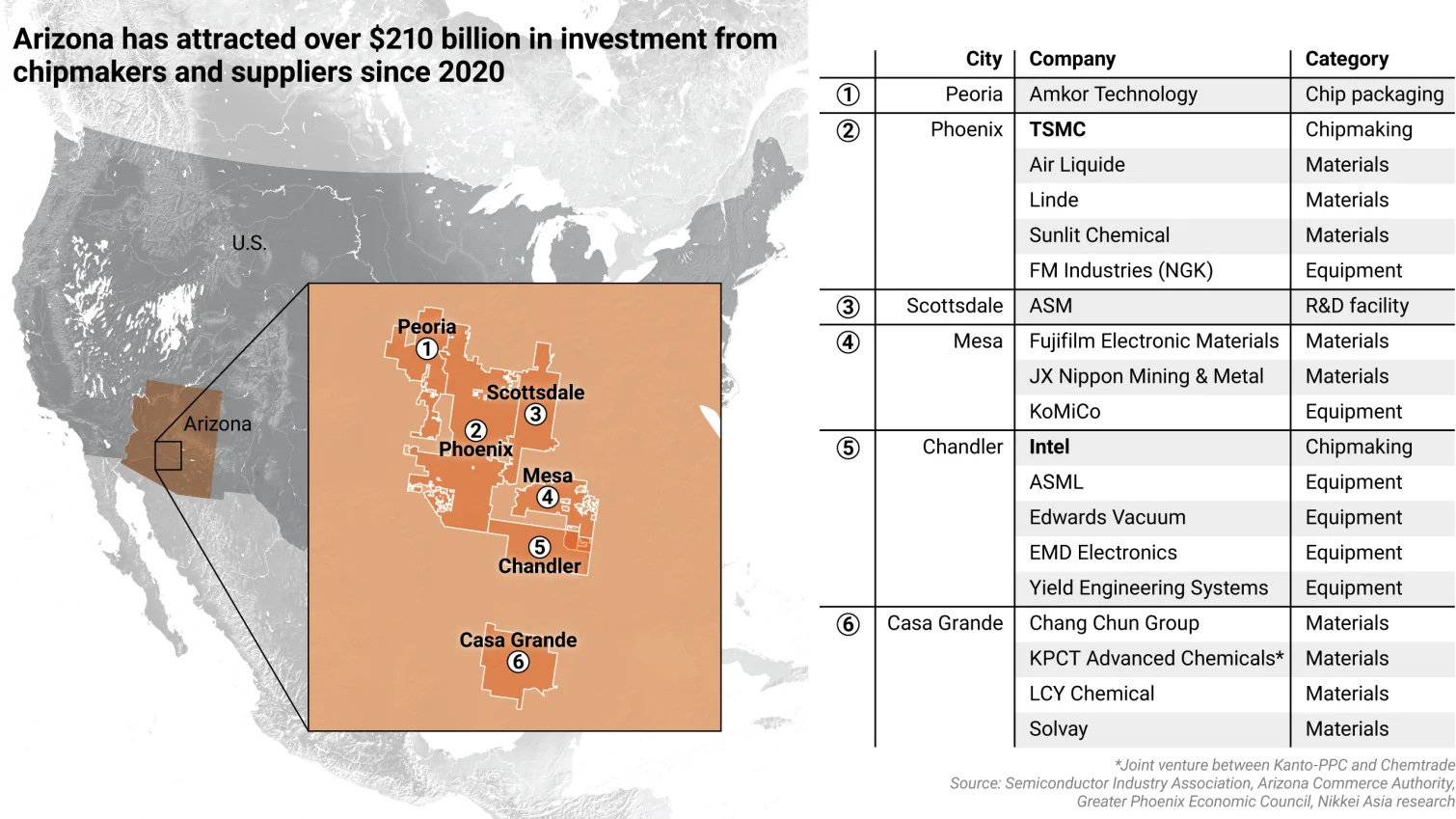
The semiconductor buildout unfolding in Arizona, as detailed by Nikkei Asia, is one of the most significant industrial experiments currently underway in the U.S. Since 2020, the state has seen more than 60 announced projects, totaling over $210 billion in investment and anticipated to create 25,000 new jobs. The early phase was messy, characterized by 16-hour workdays, slow and often painful permitting queues, ballooning costs, and real labor shortages that forced several chipmakers and chemical suppliers to pause their plans. But the tide seems to be turning. TSMC’s Arizona fab is now producing chips for Apple and Nvidia’s Blackwell processors, and the supplier base is finally finding its footing. Sunlit Chemical is storing materials for competitors without local infrastructure, while Topco Scientific is building a supply-chain platform designed to help smaller suppliers go global, demonstrating an ecosystem that is growing in confidence. This is the playbook the U.S. should continue to replicate across other manufacturing categories. Start by anchoring a selected region with a world-class foreign leader in a specific sector who brings irreplaceable process and production expertise. Then build density by cultivating upstream suppliers until the ecosystem becomes self-sustaining.
Some Interesting Reads:
Deloitte released both its 2026 Manufacturing Industry Outlook and its 2026 Aerospace and Defense Industry Outlook. Below are some of the takeaways:
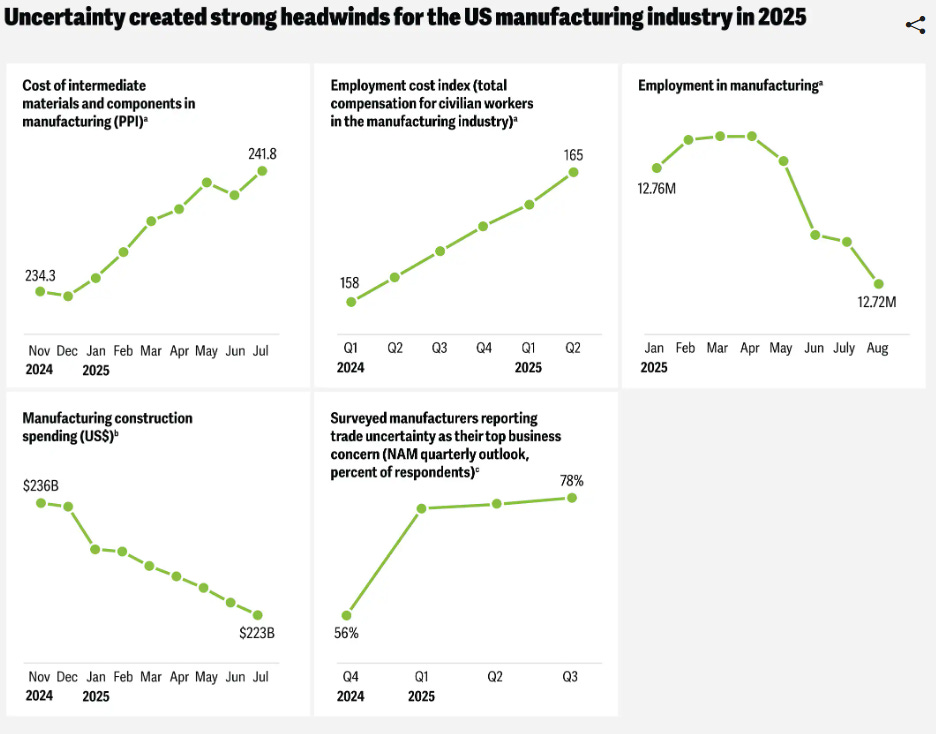
78% of manufacturers responding to the NAM Q3 Survey reported that trade uncertainty remains their top concern, and they expect input costs to increase by an average of 5.4% over the next year.
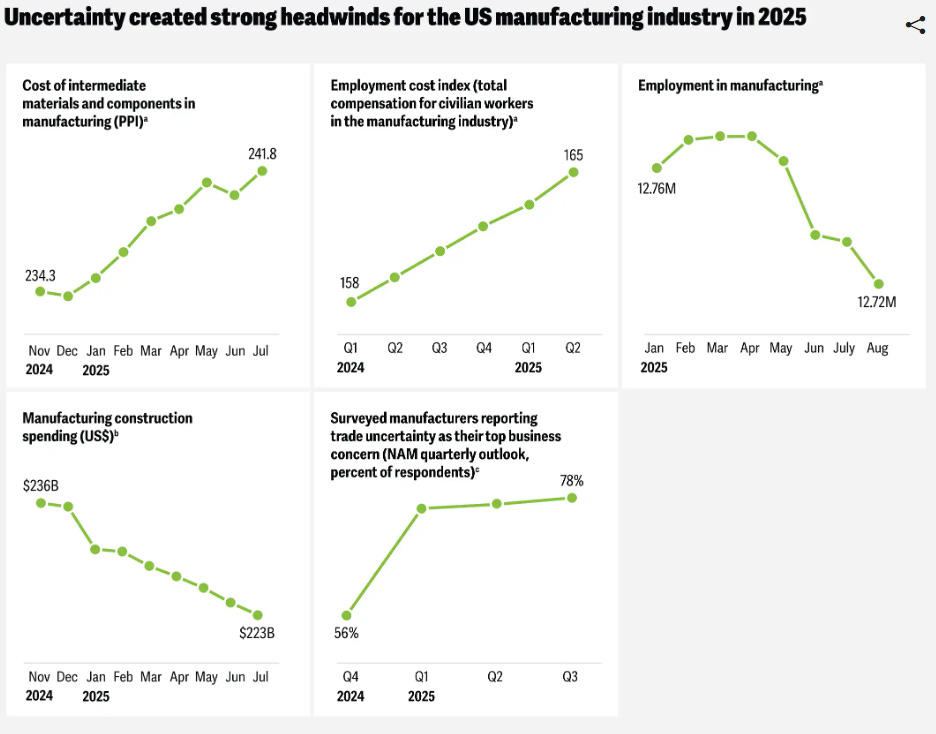
Data science, data engineering, AI, data analysis, machine learning, and statistical analysis are expected to be the fastest-growing skills, with the percentage of industrywide job postings requiring data analysis skills projected to increase from 9% in 2025 to nearly 14% by 2028.
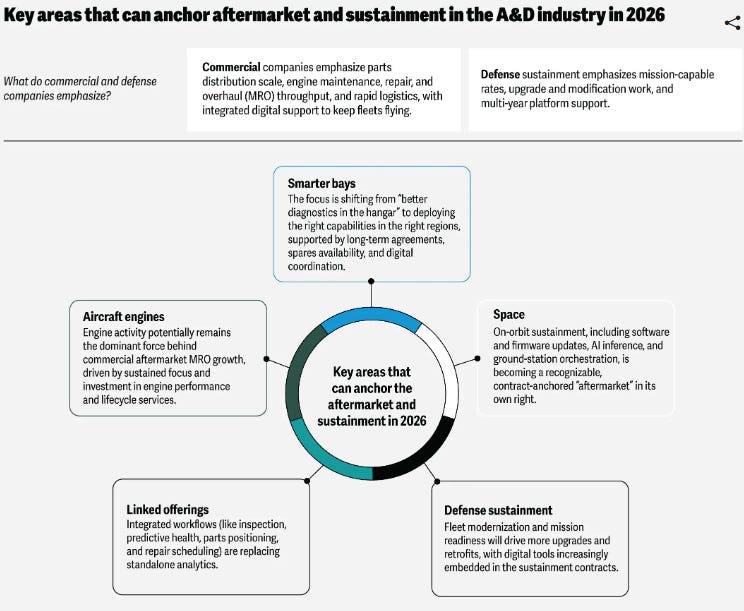
Aftermarket services can be a significant revenue source and profit driver for industrial manufacturers, delivering margins that are more than twice as high as those from equipment sales alone.
Ford is struggling to fill its 5,000 open mechanic positions, despite a $120,000 salary. [Forbes]
A new paper on Generative Latent Prediction (GLP) architecture of world modeling, which brings perception, state, action, and causality into a single, coherent world model. [MBZ]
Furniture manufacturers are permanently shifting their production away from China to the U.S. and Vietnamese markets, despite President Trump’s temporary tariff truce with Beijing. U.S. Census data support announcements like Man Wah USA's investment of hundreds of millions in a 5.8-million-square-foot Vietnamese facility. [NY Times]
Manufacturers head into 2026 with tariff uncertainty but tailwinds from the One Big Beautiful Bill Act, which restores immediate expensing for R&D, which now clearly spans shop-floor process changes, machinery debug, and line rearrangements, unlocking cash and tax credits to fund AI, automation, and M&A. [Supply Chain Dive]
An interesting post by Jose Pedro Silva on multi-cloud MES deployments states that the most pragmatic architectures maintain synchronous replication within single metropolitan regions to ensure zero data loss in local failures, while using asynchronous replication for cross-region links with defined recovery point objectives of 1-5 minutes. [Jose Pedro Silva]
Products & Releases:
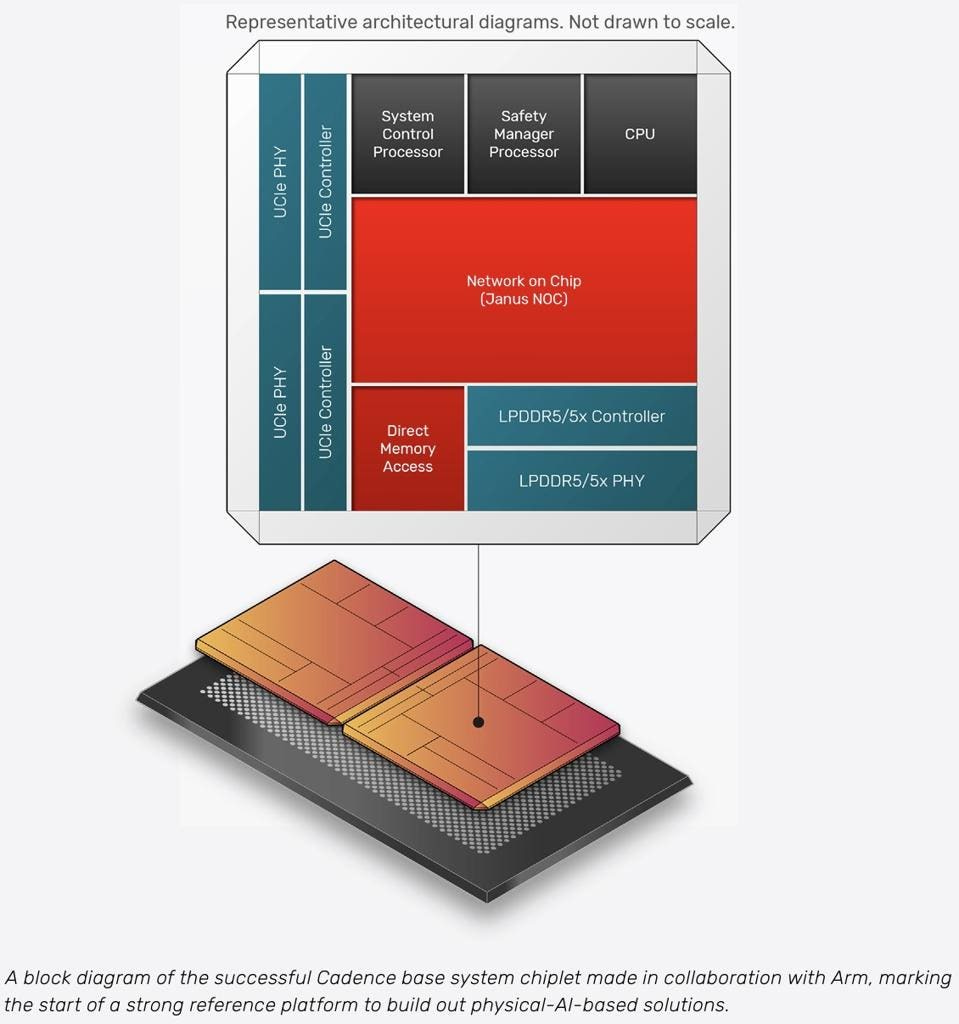
Cadence Design Systems’ successful silicon bring-up of its system chiplet architecture marks a significant milestone in the semiconductor industry’s shift toward modular, chiplet-based design. The platform validates a cohesive approach to integrating system processors, memory controllers, and Network-on-Chip functionality, potentially accelerating development timelines for edge AI and physical AI applications. However, the larger challenge now is commercial. Cadence must translate this technical achievement into broad customer adoption and prove that the economics of advanced packaging and heterogeneous integration offer meaningful advantages over competing chiplet strategies. This will be especially critical as edge AI and autonomous-driving systems place increasing demands on performance, power efficiency, and thermal management. [Forbes]
Amazon’s Nova Pro large language model demonstrates a breakthrough approach to manufacturing quality control by detecting visual defects without requiring any training data, specialized datasets, or model retraining when production conditions change. In benchmarking against the MVTec anomaly detection dataset of toothbrushes, the LLM-based approach initially achieved 81% accuracy but reached 93% accuracy with simple prompt refinements made in plain English.
Jeff Bezos launches Project Prometheus, focusing on AI that will help in engineering and manufacturing across computers, aerospace, and automobiles. [NY Times]
QAD Redzone announced Redzone Connected Workforce, designed to improve productivity by empowering the frontline. QAD Adaptiv, the intelligent backbone ERP software, and Champion AI, the Agentic AI engine powering both platforms, were also introduced. [QAD]
Schaeffler will supply planetary gear actuators, which are used in robotic joints that carry out precise rotational movements, to Neura Robotics. [Automotive Logistics]
Podcasts & Blogs

Finance & Transactions 💵
Harbinger - A company that manufactures medium-duty electric and hybrid vehicle platforms designed for last-mile delivery and commercial fleet applications.
$160 million [Series C] - Co-led by FedEx, Capricorn’s Technology Impact Fund, and THOR Industries.
CoLab - A company building and AI-powered EngineeringOS transforming how design teams work together, review technical data and make critical decisions.
$72 million [Series C] - Led by Intrepid Growth Partners and joined by Insight Partners, YC, Pelorus VC, Killick Capital, and Spider Capital
Carbon - An additive manufacturing company enabling production of high-performance polymer components.
$60 million [Financing] - Led by Sequoia Capital and Silver Lake
Fabric8Labs - A room-temperature 3D metal printing technology that produces complex, dense metal parts without post-processing.
$50 million [Financing] - Led by NEA and Intel Capital
Foxglove - A company building a data and observability platform for Physical AI and robotics.
$40 million [Series B] - Led by Bessemer Venture Partners and joined by Eclipse and Amplify Partners.
Forgis - A company developing software to automate industrial machines.
$4.5 million [Preseed] - Led by Redalpine
Litmus - The leading industrial edge data and operational intelligence platform.
$## million [Financing] - Led by Insight Partners and Munich Re Ventures
Planned Downtime 🧑🔧
Satya Nadella – How Microsoft thinks about AGI
Breaking the Bottleneck is brought to you with support from our partners.
Industry 4.0 Club - Leading cross-functional group accelerating the adoption of Industry 4.0, delivering better experiences to consumers, better profits to manufacturers, and better jobs to factory workers.
OMNI VC - Leading manufacturing tech VC, investing in Manufacturing Tech startups at the earliest possible stage.